
Brown v. Board Changed Everything and Nothing
Twenty years after Brown v. Board, the Supreme Court made the practical implementation of school desegregation impossible.

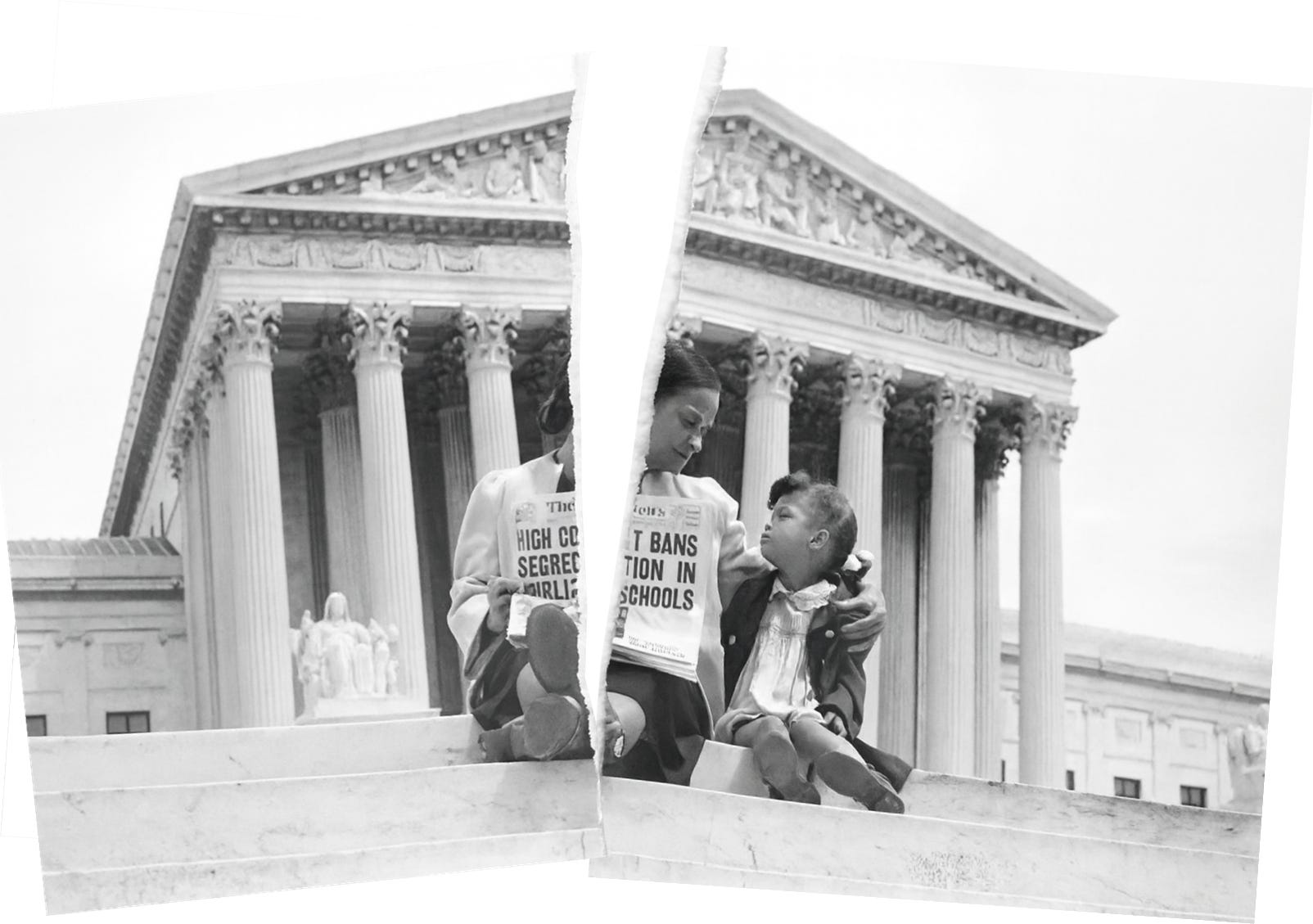
May 1954: Nettie Hunt and her daughter Nickie sit on the steps of the US Supreme Court, after the high court’s ruling in the Brown vs. Board of Education case that segregation in public schools was unconstitutional. (Photo: Bettmann / Corbis)
In 1954, the Supreme Court ruled unanimously in Brown v. Board of Education that “separate but equal” public schools were inherently unequal and violated the 14th Amendment. While the ruling did not result in immediate school integration, it did spawn active resistance from segregationists. School boards held hearings and ignored orders to integrate. Then Whites resorted to violent attacks on Black students, closed public schools, and created Whites-only private schools. Ten years after the Brown decision, 98% of Black children in the South were still in segregated schools.
The backlash to desegregation was seen in the rapid mass exodus of Whites from the cities, doubling the suburban population in a decade, a growth rate that took over thirty more years to replicate. And in 1968, voters elected, Richard Nixon, who opposed integration, to be President. Nevertheless, fifteen years after Brown, school segregation was finally ended on October 29, 1969, when the Supreme Court again unanimously ruled in Alexander v. Holmes that “every school district is to terminate dual school systems at once and to operate now and hereafter only unitary schools.”
The flight of Whites from cities doomed school integration. Although school district boundaries were facially race-neutral, they were drawn on maps created with explicitly race-based housing laws. The 6th Circuit ruled that the only way to desegregate Detroit city schools was to integrate them with suburban schools. However, in 1974, the Supreme Court disagreed in Milliken v. Bradley. In the 5–4 decision, the majority – four of whom were appointed by President Nixon – wrote that, if the suburbs hadn’t caused Detroit’s problems, they couldn’t be forced to solve them. Dissenting Justice Thurgood Marshall wrote, “The very evil that Brown was aimed at will not be cured but will be perpetuated.” He added, “Our nation, I fear, will be ill served by the court’s refusal to remedy separate and unequal education, for unless our children begin to learn together, there is little hope that our people will ever learn to live together and understand each other.” In 1968, 77% of Black students in US schools attended majority non-White schools; it rose to 81% in 2018.
Recommended reading: How a Fifty-Year-Old Supreme Court Decision Fuels School Segregation Today
Yes!
There is an interesting story about Nixon pushing Abe Fortas off the Supreme Court. This tilted the court enough to start limiting the previous desegregation rulings.
This is my post I published today. It outlines the pushback against desegregation at the local level. Fairfax County, Virginia
https://open.substack.com/pub/jimthehistorian/p/fairfax-county-desegregation-separate