
Which America Endures?
Birthdays remind us that we are no longer who we were, and that we also have enduring traits that make us who we are.

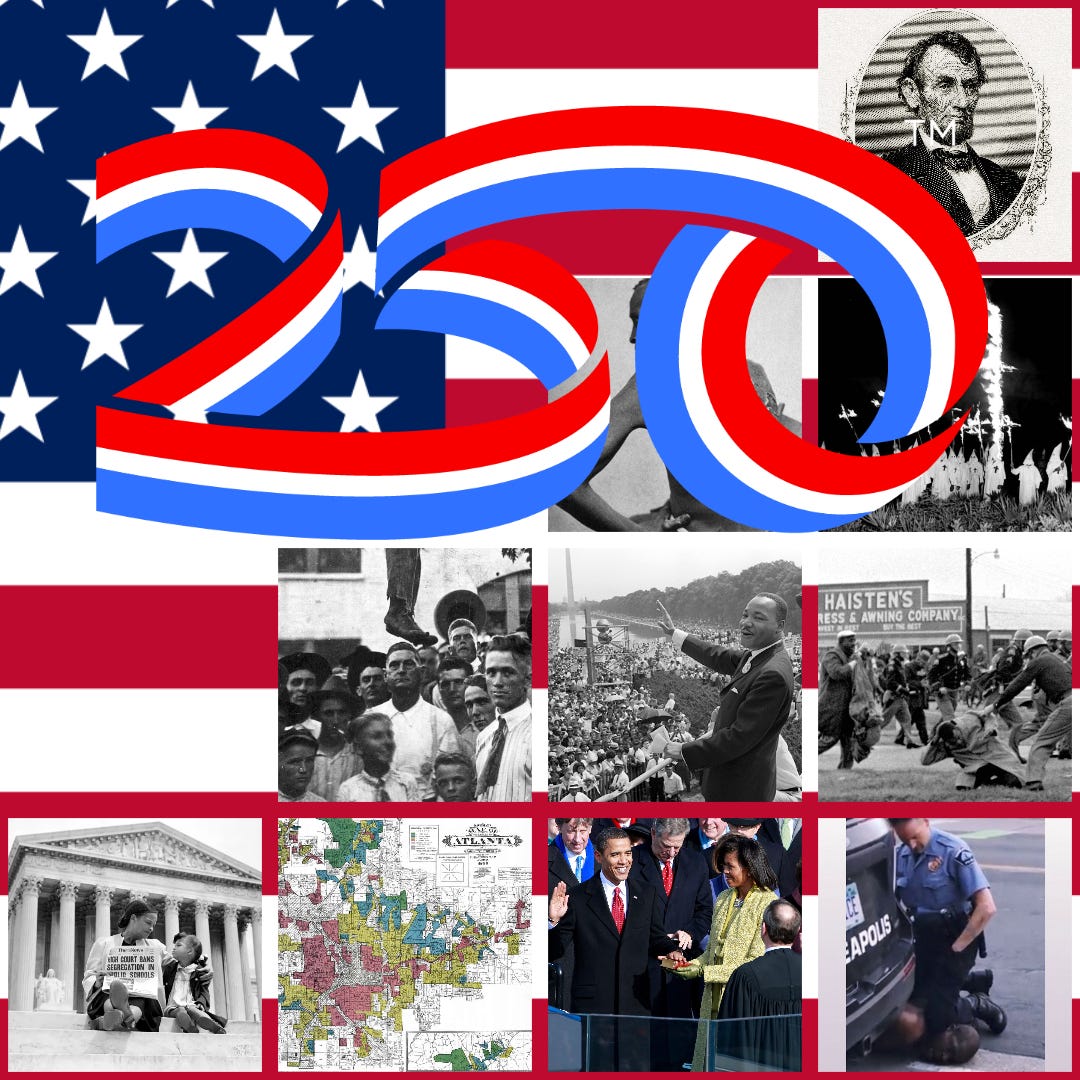
Photo collage by Lester Craven
In July 1776, the United States of America was founded by a group of White men who desired to become self-governing, independent, and free from outside oppression. The Supreme Court later wrote that “the enslaved African race were not intended to be included, and formed no part of the people who framed and adopted this [Declaration of Independence].”
In July 1868, the 14th Amendment was officially adopted into the Constitution, granting citizenship to Black people born in the US. America was willing to sacrifice 750,000 lives over the question of slavery but unwilling to give up the wealth it had accumulated under slavery. Consequently, the four million newly freed slaves were left destitute. America’s leaders, who had been influenced by the rise of scientific justifications for White racial superiority, could not tolerate the idea that citizenship for Blacks made them equal to Whites. So they passed laws making Blacks second-class citizens to remind them that they could serve society but not share its power. When laws were not enough, KKK terrorism made up the difference.
In July 1964, the Civil Rights Act ended the apartheid era by making Black citizenship equal to White citizenship. Although the expression of White supremacy through separate but equal systems was no longer legal, systems that produced racialized results continued to operate. America made no attempt to close the value gap widened by Jim Crow, and reforms that appeared to be race-neutral produced racialized outcomes that are the current manifestation of White superiority. While Black citizens are now eligible for positions of power, only five states have had a Black governor, only nine states have had a Black senator, and only one percent of Fortune 500 company CEOs have been Black. America was willing to give up a token amount of power but unwilling to give up the wealth it had accumulated under Jim Crow. Systems built with structuralized racism were designed to endure, and because they were never eliminated, they have adapted to changing times. Where mobs once carried ropes, modern enforcers carry badges. Where poll taxes once disenfranchised Black voters, voter ID laws produce the same effect. Where housing segregation was once enforced by law, freeways have cemented racial separation.
The concept of racial superiority was invented by White people to justify exploiting Black people for political and economic advantage. It is a foundational feature of America’s history, and it is still effectively accomplishing what it was intended to do by accruing benefits for White people at the expense of Black people. The inability to achieve racial equality thus far shouldn’t be viewed as a failure, but rather as the successful operation of the original design. The struggles for equal opportunity and equal protection under the law are never over, they are never won. In July 2026, which America will be celebrated?
Recommended reading: The Half Has Never Been Told: Slavery and the Making of American Capitalism by Edward E. Baptist