

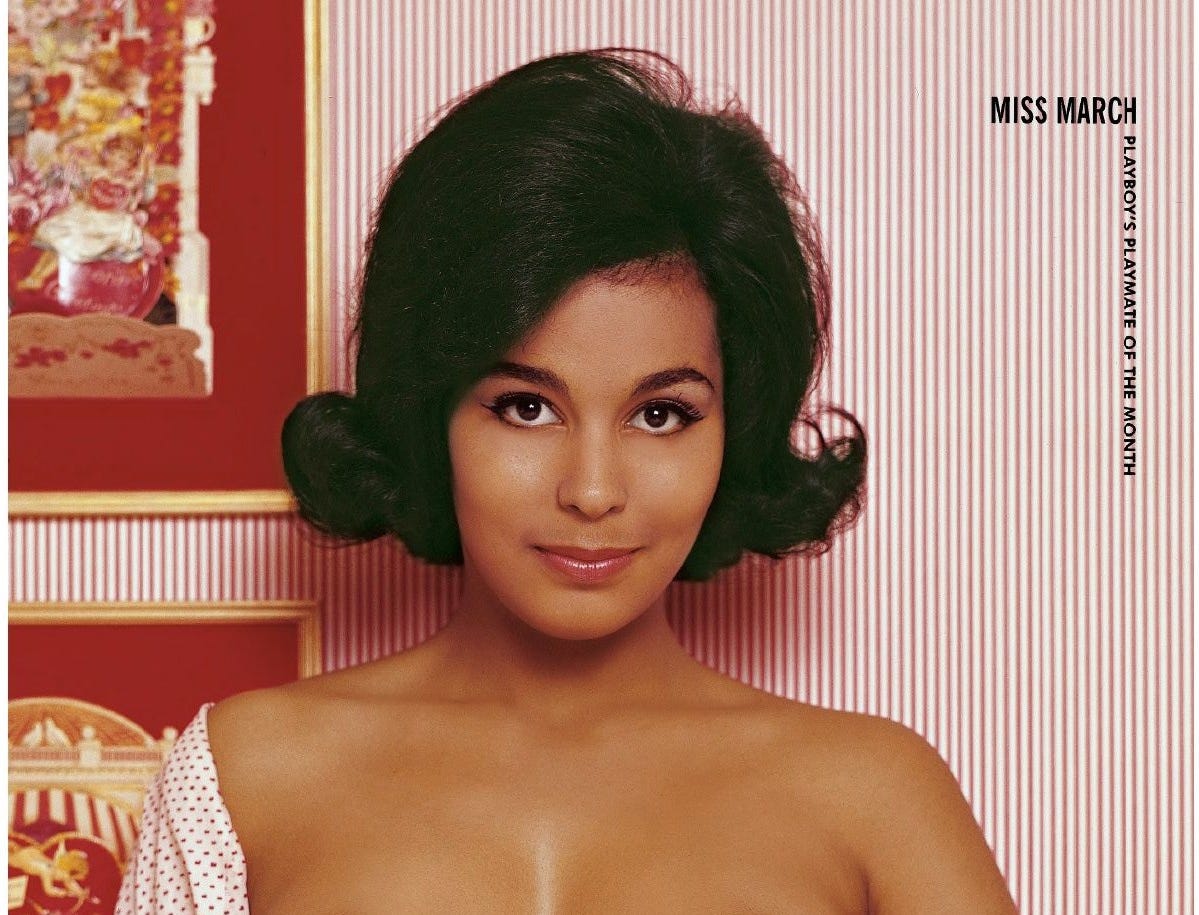
Jennifer Jackson was the first Black model to be featured in Playboy magazine’s signature centerfold. (Photo: Playboy, March 1965, Vol. 12, No. 3)
In Toni Morrison’s 1970 novel The Bluest Eye, Claudia is a Black girl living in 1940s Ohio who has internalized a deep-seated sense of self-hatred because she does not match society’s beauty standards, which are socially constructed on White superiority. Because she lacks the qualities valued by the community, she has a low sense of self-worth, which manifests as anger and defiance in response to rejection. She destroys a White doll and refuses to admire Shirley Temple, resenting the idea that she should admire that which resembles nothing of herself. Claudia’s rejection of societal values allows her to show compassion for Pecola, another Black girl who suffers immensely from believing she will always be ugly.
In March 1965, Hugh Hefner challenged the dominant culture’s beauty standards by choosing Jennifer Jackson as the first Black Playboy centerfold, an extraordinary move given that, for decades, Black women had been portrayed in media almost exclusively as maids. Nevertheless, high profile recognition of Black beauty remained scarce. Vogue magazine, the standard-bearer for women’s beauty for the previous 82 years, finally featured a Black woman, Beverly Johnson, on its cover in 1974. The Miss America pageant, which began in 1921, had a rule stating that contestants had to be “of the white race.” Even after removing this rule in the late 1960s, state pageants continued to exclude Black participants. It wasn’t until 1984 that Vanessa Williams became the first Black woman to win Miss America.
In the 1980s, just south of Ms. Morrison’s hometown in Ohio, Victoria’s Secret began selling lingerie nationwide through its mail-order catalog, generating more than $100 billion over the next four decades. Yet, it didn’t feature a Black woman on its cover until Tyra Banks in 1997. Similarly, the Sports Illustrated swimsuit issue, first published in 1964, was the magazine’s best-selling issue every year, yet it didn’t feature a Black woman on its cover until Ms. Banks in 1997. People magazine first named a Black woman, Halle Berry, as the World’s Most Beautiful Woman in 2003 and has only done so twice more with Beyoncé in 2012 and Lupita Nyong’o in 2014.
Recommended reading: The Bluest Eye by Toni Morrison
Black self-rejection and self-hatred are among the most damaging consequences of white supremacy and anti-Blackness.
I'm 30 years old, and only recently have I begun confronting the anti-Blackness I've internalized. It's difficult work, but it may be some of the most important work Black Americans can do. The process of deprogramming has to begin within us.
My hope is that we would extend the same compassion Claudia showed, both to ourselves and to those still carrying the weight of anti-Black lies.
Black is so damn beautiful. ♥️✊🏾
I did not know this, the specifics. Some of the most beautiful women I've known are black women. Some of the kindest, most empathetic souls have been black women. Thank you so much for sharing this.